
Reviewed · BRUSSELS HOP-ON HOP-OFF BUS TOURS
Brussels Tootbus Discovery Hop On Hop Off Bus and walking tours
Brussels feels big until you ride this loop. I like the 100% electric buses and the included multilingual audio commentary, which lets you move at your pace instead of cramming. My main caution: stops and bus timing can be annoying if you expect everything to be perfectly marked and on-the-minute, and a few people reported app tracking not matching reality.
The hop-on hop-off setup is simple: you ride, you get off when you want photos or a break, and you hop back on when it suits you. You can also use the Tootbus app for bus tracking, stop-finding, and the walking-tour layer called Tootwalk.
This is a strong way to get oriented, especially for a first trip, but you’ll do best with flexible expectations and a small buffer for waiting in busy zones.
In This Review
- Key things I’d pay attention to
- A freedom pass through Brussels, without the map scramble
- The practical bus experience: electric ride, two decks, and real-world comfort
- How the route really flows across Brussels stops
- Stop-by-stop: Central Station to Grand-Place and Manneken Pis
- Poelaert and the courthouse area: views and scale, with plenty of walking
- Luxembourg to Place Royale: the softer, scenic middle act
- Cinquantenaire: a classic Brussels landmark stop
- The second loop: Rogier, De Brouckère, and the European scale climb
- Atomium and Mini Europe: the stop everyone remembers
- Using the Tootbus app: great when it works, annoying when it doesn’t
- Audio commentary reality check: music balance, device options, and stop accuracy
- Tootwalk walking tours: how the walking layer changes the day
- Price and value: when this pass is worth your money
- Who this suits best, and who should rethink it
- Should you book the Brussels Tootbus hop-on hop-off and Tootwalk?
Key things I’d pay attention to

- Electric bus comfort: 100% electric ride is a win, but cobblestones and deck temperature can affect comfort.
- Audio through the bus and the app: you’re not stuck with one method if seat audio is spotty.
- App bus tracking can help a lot: it also can frustrate if live timing feels off, so plan extra time.
- Stop-finding is the make-or-break detail: some stops are easier than others to locate quickly.
- The route covers major neighborhoods: you can cover Grand-Place to Atomium in one day without long cross-city transfers.
- Tootwalk adds walkable context: it’s a good complement when you want to slow down and read a place beyond the bus window.
A freedom pass through Brussels, without the map scramble

The big idea here is choice. You get a hop-on hop-off pass (24, 48, or 72 hours), and the bus route links many of Brussels’ best-known stops so you can decide what gets your time.
What makes it work in real life is the audio layer. You’ll hear commentary in multiple languages, and you can also access audio through the Tootbus app, which is handy when you’re outside the bus or if a seat jack or audio playback is finicky.
My other favorite part is the built-in “city glue” for navigating. The app isn’t just a ticket wallet; it’s also meant to help you locate stops and follow buses in real time, so you’re not constantly guessing where you are and what direction to walk.
The main risk is the last mile: where you stand matters, and so does timing. Some people found stops not well marked and reported longer waits than the advertised schedule, so you’ll want patience and a quick way to double-check where the bus is.
Stay on the bus, more hop-on hop-off loops
- Brussels: Hop-On Hop-Off Bus Tour
★ 4.0 · 4,016 reviews - Brussels Highlights Walking and Bus Tour w/ Waffle
★ 3.5 · 430 reviews - Brussels Highlights: Walking & Bus Tour with Waffle Tasting
★ 4.2 · 233 reviews
The practical bus experience: electric ride, two decks, and real-world comfort
This is an eco-friendly ride on a 100% electric bus, which is exactly the kind of amenity that fits Brussels well. The city is full of streets that feel better handled by a vehicle than by shoe-leather—especially if you’re hopping between neighborhoods.
Inside, you’re likely to choose between an upper open-air feel and a lower deck that can feel warmer or colder depending on conditions. One theme from experiences: the upper deck can make the bus feel cold, especially if you’re riding in cooler months or if the top is open. On hot days, a couple of people reported air-conditioning issues, which is always worth noting because Belgium summers can be sweaty.
One more comfort detail: there’s free Wi‑Fi onboard listed, but a small handful of people said it didn’t work reliably. So don’t build your whole plan around streaming. Use your phone for the app and audio, but keep offline options in mind.
Also, don’t expect a restroom onboard. That’s not included, so if you’re planning a long outing between hops, you’ll want a bathroom stop plan before your ride gets spread out.
How the route really flows across Brussels stops
The route is built around two halves that connect key “greatest hits” areas. One loop ties together Central Station, Old Town icons like the Grand-Place and Manneken Pis, plus major civic landmarks such as Poelaert and the courthouse area. The second loop pulls you toward the European-looking side of the city and then up to the Atomium and Mini Europe zone.
In practice, that means you can do this like a classic first-day plan: start near Central Station, cover the historic core and viewpoints, then finish with the big modern postcard stops.
A single loop may feel like more than an hour once you factor in getting on, getting off, and traffic. One person clocked a ride at about 2 hours 15 minutes across a large area, and that tracks with the reality that Brussels traffic can change the timing a lot. The good news: because your ticket lasts 24 to 72 hours, you can spread it out instead of forcing everything into one sprint.
Stop-by-stop: Central Station to Grand-Place and Manneken Pis
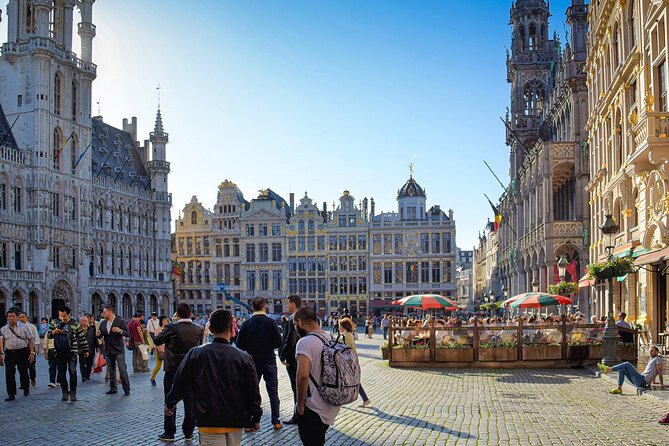
The first anchors are in the Central Station area: the route includes Rue du Cardinal Mercier 33 near Central Station, listed as Stop 1.
This is a smart place to start because it’s a major hub. If you’re landing by train, you can often get set up fast and begin your day without a long taxi shuffle.
From there, the route heads to the iconic Old Town stop at Rue du Lombard 68, which is your connection to Grand-Place / Manneken Pis (Stop 2).
This is where the hop-on hop-off idea shines. Grand-Place is compact but visually dense; you’ll want time for photos, and you’ll likely want to wander a little without worrying about the next bus leaving. Manneken Pis is small, but the area around it is where the atmosphere lives, and having the bus as your reset button is useful.
The one drawback to keep in mind: some people said stops weren’t well marked. If you land here and you’re in a hurry, don’t just stare at street corners. Use the app to verify where the stop is and where the buses will come through.
Brussels at walking pace, more routes


Poelaert and the courthouse area: views and scale, with plenty of walking
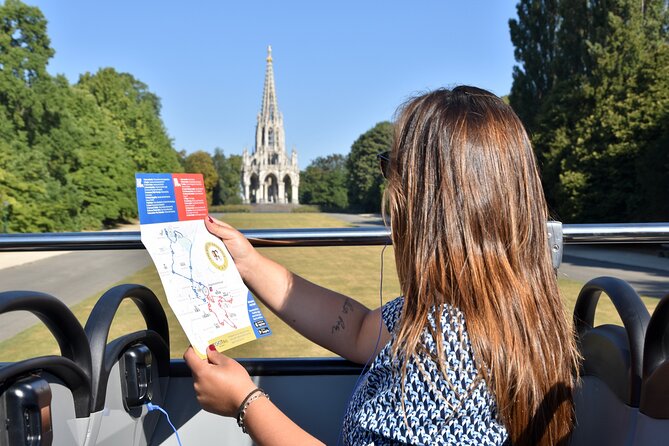
Next up is Rue des Quatre Bras, your gateway to Poelaert / Louise / Courthouse (Stop 3).
This area has the kind of grand civic scale that reads as Brussels’ “big statement” side. The bus gives you an efficient way to reach it, but you’ll still likely walk around a bit once you’re there because viewpoints and buildings rarely line up perfectly with a single photo angle.
One practical consideration: if you’re pairing this stop with another nearby hop, keep expectations realistic about walking time. Brussels’ streets can be a mix of flat and steep segments depending on exactly where you step out, and the hop-off approach only works well if you don’t lose too much time crossing between points.
Luxembourg to Place Royale: the softer, scenic middle act
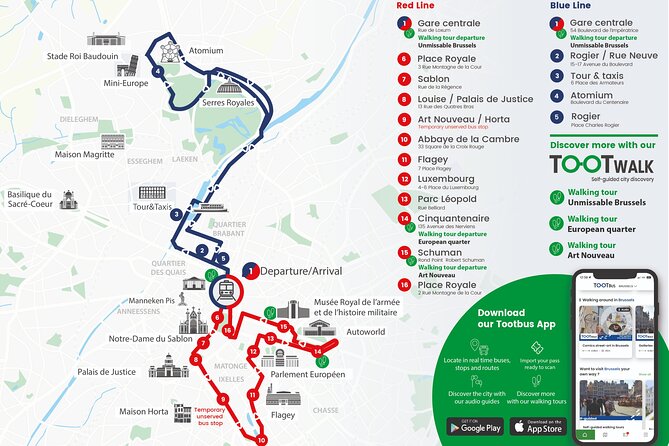
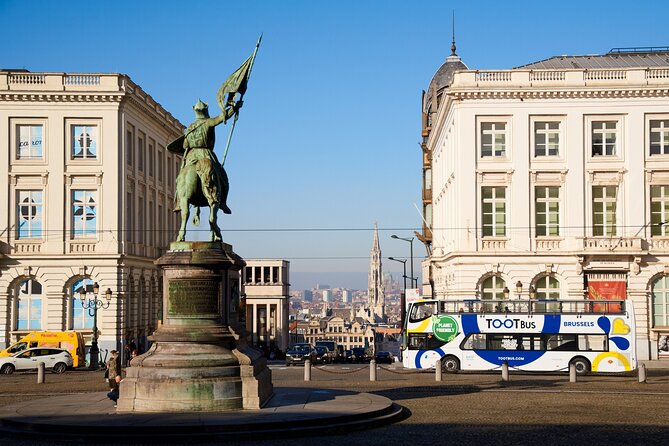
Then the route shifts to Pl. du Luxembourg 2, marked as Stop 4, with the Luxembourg area as the stop theme.
This is a great “pause” stop. It’s where you can take a breather between the flashier postcard zones. If you like sitting in a plaza or park setting and watching city life rather than only touring buildings, this is often the stop that makes the day feel less rushed.
From there, you reach Rue de la Régence 2 for Place Royale (Stop 6). Place Royale gives you that more formal, structured feel, and it can be a good contrast to the busier, more tourist-scrappy pockets closer to the Grand-Place.
The value here is pacing. By the time you get here, you’ve already had the must-see icons, and now you’re seeing a Brussels that feels more lived-in and architectural.
Cinquantenaire: a classic Brussels landmark stop
The route includes Av. des Nerviens 131 for Cinquantenaire (Stop 5).
This area is worth your attention because it’s one of those “arrive, look up, then take a long look around” stops. Even if you don’t spend hours here, it helps your overall understanding of the city when you can connect the modern-looking and historic-looking parts of Brussels without hopping taxis.
This is also where timing matters. If you’re riding during peak hours, buses can bunch up and then spread out again. If you plan lunch or a longer pause at Cinquantenaire, give yourself more slack than you think you need.
The second loop: Rogier, De Brouckère, and the European scale climb

The return-style portion includes Rue du Cardinal Mercier 33 again and then continues with Av. du Boulevard 21 for Rogier (Stop 2 in the second sequence).
Rogier is more of a connector stop, a place where you can transition between central streets and larger districts. It can be useful if you want to avoid a backtrack walk.
Next is Boulevard du Centenaire, tied to Atomium & Mini Europe (Stop 3 in the second sequence). This is the big destination that makes the second loop feel worth it.
Before that, you also get Rue de l’Evêque 7 for De Brouckère – Centre (Stop 4 in the second sequence). This can help if you want more direct access to central shopping streets and transit connections.
Atomium and Mini Europe: the stop everyone remembers
When people decide to do a hop-on hop-off bus, it’s often because they want a one-vehicle route to the Atomium. Here, it’s explicitly on the route as Atomium & Mini Europe.
This is one of those Brussels landmarks that looks different from multiple distances, and you’ll want a little time to get your bearings and grab photos from a couple of angles. The bus helps you reach it without turning your day into a transit puzzle.
One caution from real experiences: some people described long waits at major points like Atomium. If your day hinges on a timed entry ticket somewhere nearby, build extra time between your bus hop and your scheduled plan.
Using the Tootbus app: great when it works, annoying when it doesn’t
The Tootbus app is included with your access, and it’s designed for three key things: e-ticket wallet, locating stops, and following buses in real time.
When it works well, it saves time. You can identify the stop you need, and you can sanity-check whether the bus you’re waiting for is close or running late.
When it doesn’t work, the day can feel harder. Some people said the app live timing was off and didn’t match the actual bus arrival. Others also reported that the app didn’t show live bus feeds as expected.
My advice: treat the app like a strong hint, not a stopwatch. Add buffer time. If you’re early, great. If you’re running late, use the app to confirm direction and then be ready to take another local transport option if the wait stretches.
Audio commentary reality check: music balance, device options, and stop accuracy
Audio is a major selling point here. You get multilingual commentary on the bus and through the app, plus a kids audio guide designed for children.
But audio quality can vary by how you experience it. Some people found there was more music than commentary, and some said the narration didn’t line up perfectly with what they were seeing in the moment. Others said the recording focus felt more culture-oriented than true history.
If you care about strict historical detail, don’t assume every minute will be a tight timeline. Think of it as a guided orientation tool: it tells you what you’re looking at, gives context, and points you toward what’s worth your time once you hop off.
Also, if seat audio has issues (a few people reported headphone jacks not working), use the app audio commentary on your phone as your backup. Since both options are included, you’re not totally stuck.
One more note: a couple of experiences mentioned onboard plug problems at seats. So I’d charge your phone fully before you start. The free Wi‑Fi is a bonus, not your power source.
Tootwalk walking tours: how the walking layer changes the day
This experience isn’t only about bus rides. The Tootbus app also supports audio-guided walking tours called Tootwalk.
In practice, the best way to use a walking layer is to attach it to the stop you care about most. For example, do a bus hop to a landmark area, then slow down on foot while the audio gives context you’d otherwise miss from the street.
Some walking experiences within the Tootbus universe have been described as guided and equipped with radio sets, which can help you hear instructions even if you’re not close to the guide. One person named Patrick stood out for their walking tour experience, and that’s a good reminder that the walking side can feel more human than a pure audio track.
If you want a Brussels day that mixes big sights with street-level storytelling, this walking layer is where you get it.
Price and value: when this pass is worth your money
I think the value of this kind of pass depends on how you use your hops. If you treat it like a flexible shuttle between highlights—then take time at each stop—the 24, 48, or 72-hour window starts making sense.
If you only ride a small portion of the route and then end up waiting a long time for the next bus, the value drops fast. Multiple people pointed to long waits, and some described buses coming less frequently than expected, even when the schedule suggests around every 30 minutes.
So here’s the practical way to decide:
- If you’ll spend at least part of your day doing multiple stops, the pass is more likely to pay off.
- If you mainly want one or two places and you’re confident you can transit efficiently on your own, you might get better value elsewhere.
Discounts can change the math too. Some people said buying through third-party resellers offered lower prices, which makes the pass feel much easier to justify.
Who this suits best, and who should rethink it
This is great for a first-time Brussels visit when you want to cover a lot without planning each transfer. It’s also a good fit if you like independence: hop off for photos, then hop back on and continue.
It may be less satisfying if you’re the type who needs exact arrival times and zero waiting. If you have tight museum windows, treat bus timing as a variable and plan accordingly.
It’s also worth considering if you get annoyed when audio is not super history-precise or when commentary feels like it blends culture and interpretation rather than strict dates. The audio is included, but the style may not match what you expect from a traditional guided history lecture.
Should you book the Brussels Tootbus hop-on hop-off and Tootwalk?
I’d book it if you want an easy Brussels overview that connects the Grand-Place area to the Atomium zone with minimal thinking. You’ll likely appreciate the multilingual audio, the electric bus ride, and the way the app ties into both tracking and walking tours.
I’d hesitate if you’re traveling on a schedule where waiting costs you money or museum access. In that case, build buffers, and consider having a backup transit plan. If you’re sensitive to comfort issues from cold decks or reported heating or air-conditioning problems, choose your ride deck and timing wisely.
Bottom line: for most people, this is a practical first-day orientation tool. Use it to get your bearings, then spend your best time on foot where Brussels deserves it.
More Brussels Outings






More Tour Reviews in Brussels




Brussels From the Top Deck




Hot Off the Press: New Brussels Reviews





Brussels Hop-On Hop-Off Bus Tours, compared.
 ★ 4.0Hop-On Hop-Off Bus TourFrom $294,016 reviews
 ★ 3.5Brussels Highlights Walking and Bus Tour w/ WaffleFrom $45430 reviews
 ★ 4.2Brussels Highlights: Walking & Bus Tour with Waffle TastingFrom $43233 reviews
 ★ 3.7City Card with Hop-On Hop-Off BusFrom $7579 reviews
 ★ 3.8Sightseeing Sunset Bus TourFrom $3470 reviews
 ★ 4.5Bruges bus tour from BrusselsFrom $4928 reviews
 ★ 4.2Hop-On Hop-Off Bus Tour& Belgian Beer World MuseumFrom $5324 reviews
Browse the lists this tour appears in